

Daisy Việt
14-08-2026The Weekend I Learned to Make Bánh Mì with My Grandmother
A personal essay about learning to bake bánh mì with my grandmother and discovering the value of patience and tradition, combined with B2 practice on third conditionals, passive voice, and reported speech.Lượt xem: 137 Nguồn: Sưu tầm
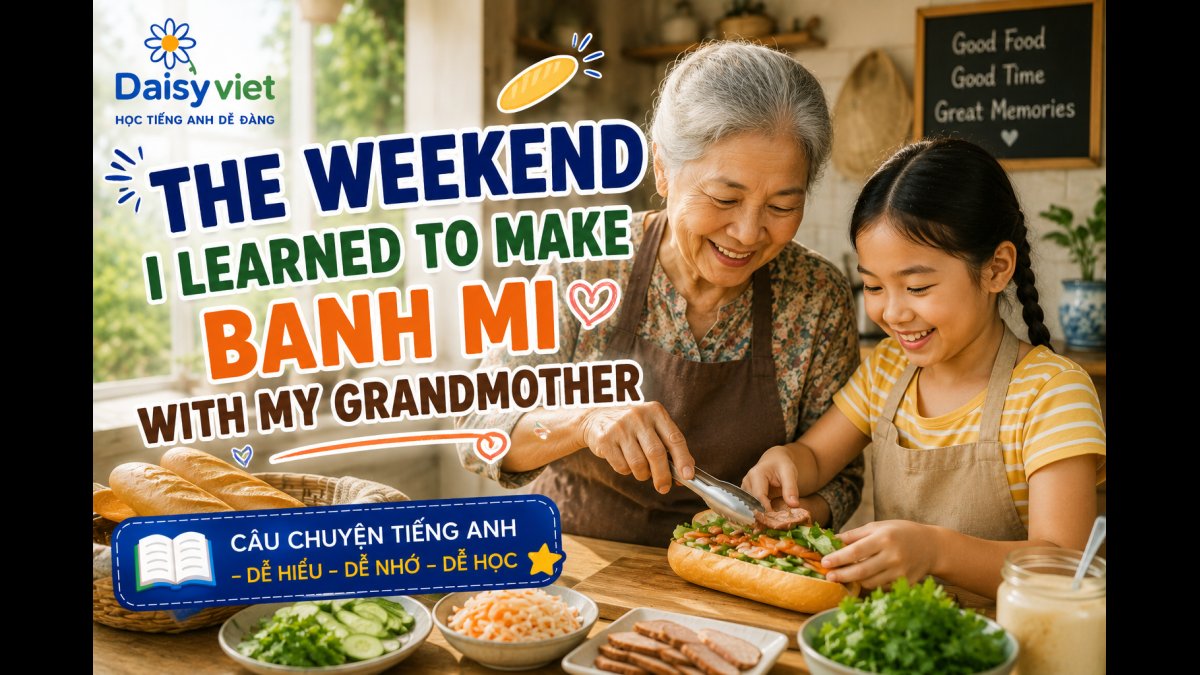
Growing up, I always thought that cooking was my grandmother's magic. Every time I visited her small house in the countryside, the kitchen was filled with the smell of freshly baked bread, and I never really understood how she did it. Last spring, I finally asked her to teach me, and that weekend turned into one of the most meaningful experiences of my life.
My grandmother, who has been baking banh mi for over forty years, told me that the secret was not the recipe itself but the patience behind it. She said that the dough had to be kneaded slowly and left to rest for exactly two hours, otherwise the bread would come out too dense. I remember thinking that this sounded far more complicated than the store-bought loaves I was used to buying.
We started early in the morning. The flour was mixed with water, yeast, and a little sugar, and then it was kneaded by hand until it became smooth and elastic. My grandmother explained that if the dough were too sticky, more flour should be added little by little, but never all at once. I tried my best to follow her instructions, although my first attempt looked more like a flat pancake than a loaf of bread.
She laughed gently and said that it was completely normal for beginners to struggle at first. "If you hadn't tried today," she told me, "you wouldn't have learned how difficult this actually is." Her words stayed with me, because they reminded me that mistakes are simply part of learning something new.
By midday, the shaped loaves were placed into a hot oven, which had been preheating for almost twenty minutes. As they baked, the whole house was filled with a warm, comforting smell that I will never forget. When the bread was finally taken out, its crust was golden and crisp, exactly the way my grandmother had described.
We ate the banh mi together with pork, pickled vegetables, and fresh herbs, sitting on the porch as the sun began to set. My grandmother told me that food made with care always tasted better than food made in a hurry. I finally understood what she meant, and for the first time, I felt like I was starting to get the hang of it.
That weekend taught me something that no cookbook ever could: that tradition is not just about following a recipe, but about the patience, care, and love that are passed down from one generation to the next.
Grammar Focus
- Third Conditional — If + S + had + V3, S + would have + V3
"If you hadn't tried today," she told me, "you wouldn't have learned how difficult this actually is." - Passive Voice — S + be (was/were) + V3
"The flour was mixed with water, yeast, and a little sugar, and then it was kneaded by hand until it became smooth and elastic." - Reported Speech — S + told/said (that) + clause, with backshift
"My grandmother told me that food made with care always tasted better than food made in a hurry."





💬 Bình luận (0)