

Daisy Việt Editorial Team
28-08-2026Should Artificial Intelligence Be Allowed to Make Medical Decisions?
AI already assists doctors in diagnosis, but how much independent authority such systems should hold over medical decisions remains fiercely debated.Lượt xem: 67 Nguồn: Daisy Việt
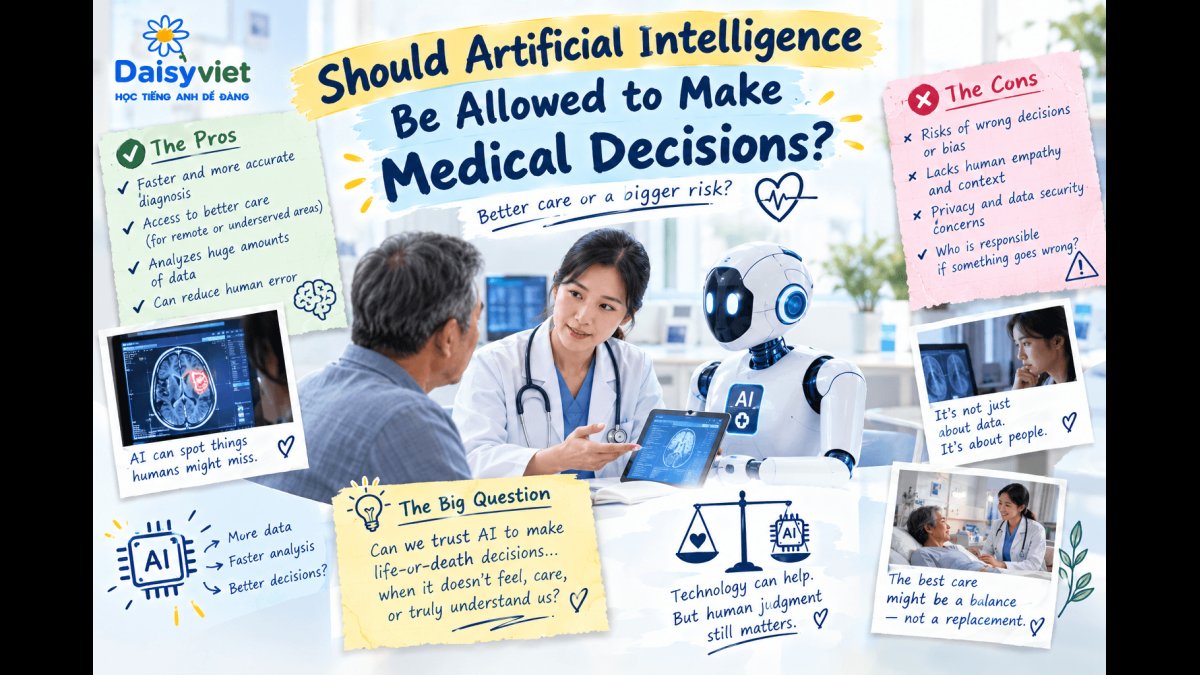
It is not whether artificial intelligence belongs in medicine that remains genuinely contested among healthcare professionals today, but rather how much autonomy such systems should ultimately be granted. Diagnostic algorithms already assist radiologists in detecting tumors, predict which patients are at risk of deterioration, and help triage emergency room cases, yet the question of whether AI should ever make a final medical decision, unsupervised by a human clinician, provokes considerably more disagreement.
Proponents of expanding AI's role point to a growing body of evidence suggesting that, in certain narrow, well-defined tasks, algorithms can outperform even experienced human specialists. Systems trained on millions of medical images have demonstrated accuracy in detecting certain cancers that rivals, and in some documented cases exceeds, that of trained radiologists, a finding that has understandably generated considerable enthusiasm within parts of the medical community.
Were such systems deployed at scale across under-resourced healthcare systems, proponents argue, they could meaningfully expand access to high-quality diagnostic care in regions facing chronic shortages of specialist physicians, potentially saving lives that might otherwise be lost to delayed or missed diagnoses in areas where qualified specialists are scarce or entirely unavailable.
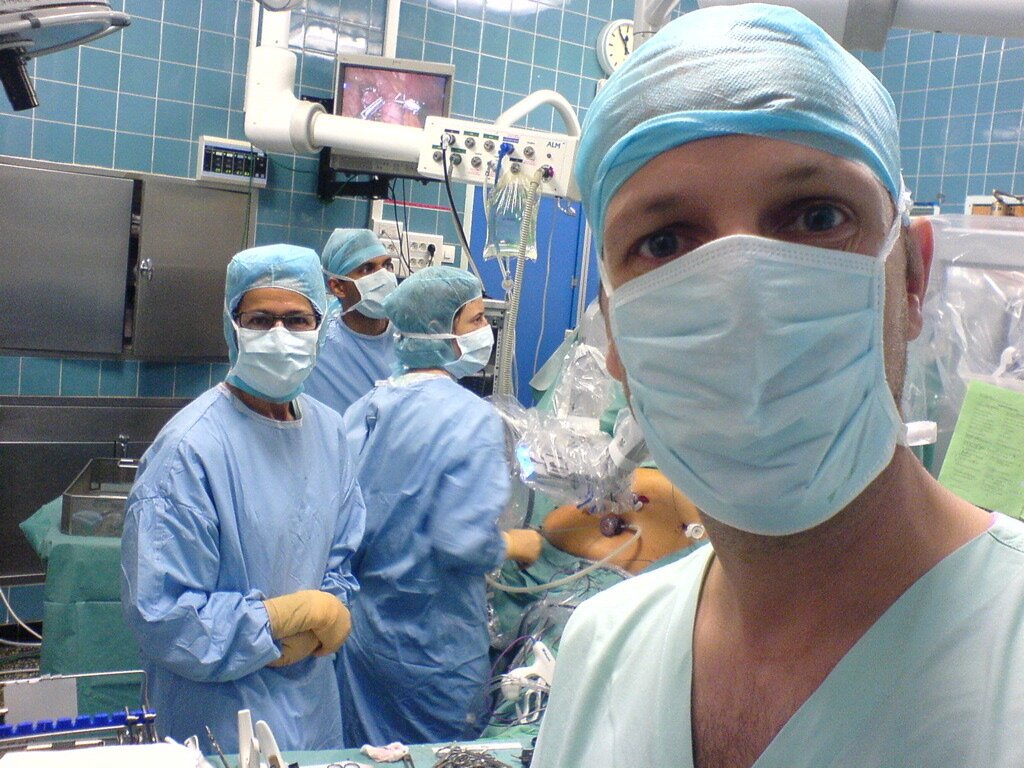
Ảnh: Nicoleon, Wikimedia Commons (CC BY-SA 4.0).
Critics, however, raise concerns that extend well beyond simple technical accuracy. It is the opacity of many AI systems, rather than their occasional errors, that troubles medical ethicists most profoundly. Complex machine learning models frequently function as effective black boxes, arriving at conclusions through processes that even their own developers struggle to fully explain, a characteristic that sits uneasily alongside medicine's long-standing emphasis on transparent, accountable decision-making.
The question of accountability, should an AI system make a consequential error, remains legally and ethically unresolved in most jurisdictions. Whereas a human physician can be held professionally and legally responsible for a misdiagnosis, responsibility becomes considerably murkier when an algorithm, trained on data whose biases may not be fully understood even by its creators, is the entity that generated the flawed recommendation.
Bias embedded within training data represents a further, deeply consequential concern. Algorithms trained predominantly on data drawn from certain demographic groups have, in documented cases, performed measurably worse when applied to patients from underrepresented populations, raising the disturbing possibility that widespread AI adoption could inadvertently entrench, rather than reduce, existing healthcare disparities.
Not all applications of medical AI carry equal risk, a distinction advocates argue is frequently lost in public debate. Few would object to algorithms that merely flag potential concerns for a human physician's review, whereas considerably more controversy surrounds proposals to allow AI systems to independently determine treatment plans, particularly in high-stakes situations involving irreversible interventions such as surgery or end-of-life care decisions.
Patients themselves, according to surveys conducted across several countries, express markedly mixed feelings on the matter. Many report comfort with AI assistance in diagnostic contexts, particularly when a human physician remains ultimately responsible for final decisions, yet considerably fewer express willingness to have treatment decisions made primarily, or entirely, by an algorithm rather than a trusted human doctor.
Regulatory bodies in several countries have begun developing frameworks specifically designed to govern medical AI, generally requiring rigorous clinical validation before deployment and mandating a degree of human oversight proportional to the stakes involved in any given decision. Whether these frameworks can keep pace with a rapidly advancing technology remains, by most informed assessments, genuinely uncertain.
What seems increasingly clear, amid this unresolved debate, is that the question is unlikely to be settled by a single, universal rule applicable across all medical contexts. A more plausible outcome, many ethicists suggest, involves a carefully calibrated spectrum of AI autonomy, expanding gradually as evidence of safety and fairness accumulates, rather than either the wholesale rejection or the unrestrained adoption that currently dominates much of the public conversation.
Insurance systems and healthcare economics add a further layer of complexity to the debate. Some analysts worry that AI-driven diagnostic tools, if deployed primarily as a cost-cutting measure rather than a genuine improvement in care quality, could pressure healthcare providers toward faster, cheaper decisions at the expense of the more careful, individualized judgment that complex cases sometimes require, particularly for patients whose symptoms do not fit neatly into the patterns an algorithm has been trained to recognize.
Physicians' own attitudes toward AI have shifted considerably over the past several years, moving from broad skepticism toward a more pragmatic acceptance, particularly among younger doctors trained during a period when AI-assisted tools were already becoming a routine part of clinical practice. Even so, a persistent minority of clinicians continue to express discomfort with delegating meaningful diagnostic authority to systems whose internal reasoning cannot be fully scrutinized by the humans ultimately responsible for patient outcomes.
Trials comparing AI-assisted decision-making against traditional physician-only workflows have generally found that the strongest outcomes emerge not from AI acting alone, nor from physicians ignoring AI recommendations altogether, but from carefully designed collaboration between the two, in which algorithms flag patterns human clinicians might otherwise miss, while physicians retain final judgment informed by context an algorithm cannot fully access.
That collaborative model, imperfect as it remains, may ultimately offer the most realistic path forward for a technology whose capabilities are advancing faster than the ethical and regulatory frameworks meant to govern it.
Grammar Structure (Phân tích Ngữ pháp)
- Cleft Sentence (câu chẻ) — nhấn mạnh thành phần câu: "It is not whether artificial intelligence belongs in medicine that remains genuinely contested... but rather how much autonomy such systems should ultimately be granted." / "It is the opacity of many AI systems, rather than their occasional errors, that troubles medical ethicists most profoundly."
- Mixed/Inverted Conditional (câu điều kiện đảo ngữ) — "Were... deployed..." thay cho "If... were deployed...": "Were such systems deployed at scale across under-resourced healthcare systems, proponents argue, they could meaningfully expand access to high-quality diagnostic care."
- Advanced Linking Device / Formal Contrast (liên từ trang trọng) — dùng "Whereas" để đối lập trang trọng: "Whereas a human physician can be held professionally and legally responsible for a misdiagnosis, responsibility becomes considerably murkier when an algorithm... is the entity that generated the flawed recommendation."





💬 Bình luận (0)