

Daisy Việt Editorial Team
28-08-2026The Global Shift Toward Renewable Energy: Progress and Setbacks
Falling costs have made solar and wind the cheapest new electricity in many markets, yet technical, political, and economic obstacles still slow the transition.Lượt xem: 67 Nguồn: Daisy Việt
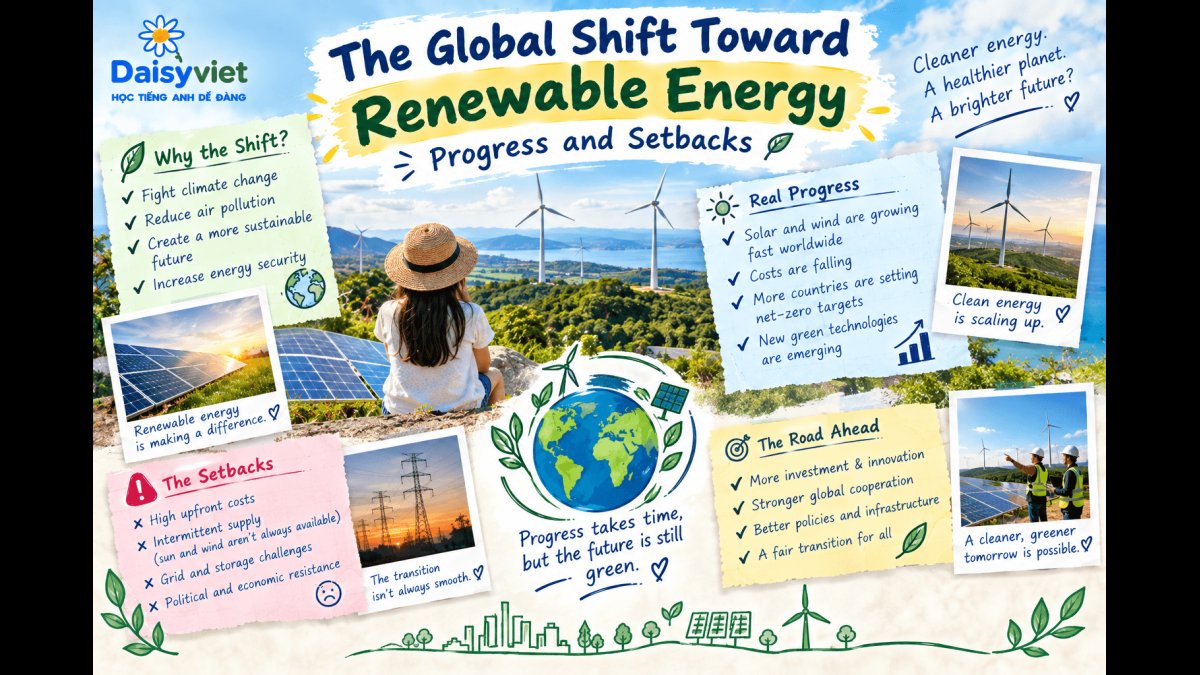
It is the falling cost of solar panels and wind turbines, more than any single piece of climate legislation, that analysts most often credit with accelerating the global shift toward renewable energy over the past fifteen years. What was once dismissed as an expensive, niche alternative to fossil fuels has, in many parts of the world, become the cheapest available source of new electricity generation.
The scale of this transformation is considerable. Solar and wind installations now account for the majority of new electricity generation capacity added globally each year, surpassing coal, gas, and nuclear combined in several major markets. Countries once heavily dependent on imported fossil fuels have found renewable energy particularly attractive, not only for environmental reasons but for the energy security that comes with generating power domestically rather than relying on volatile international fuel markets.
Were the transition proceeding smoothly and without complication, renewable energy might already account for a far larger share of global electricity generation than it currently does. In practice, however, the shift has been considerably more uneven, hampered by a range of technical, economic, and political obstacles that vary enormously from one country to another.
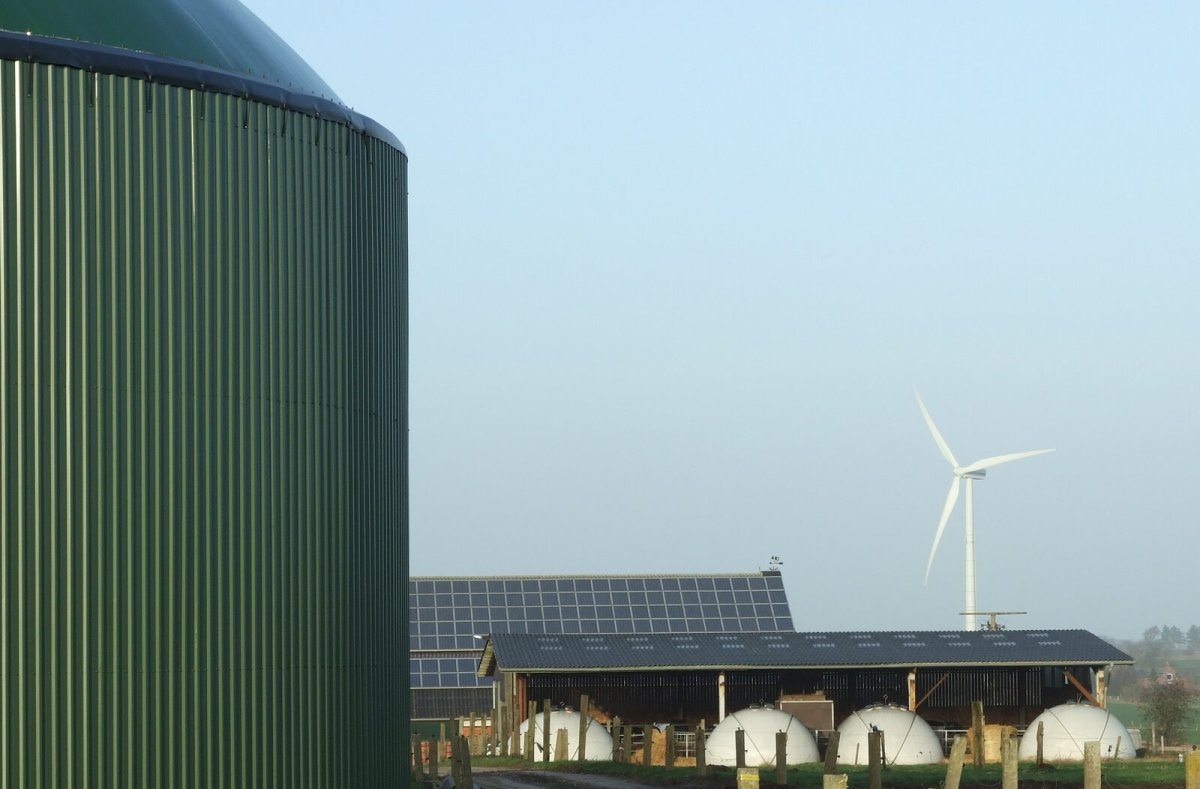
Ảnh: Florian Gerlach, Wikimedia Commons (CC BY-SA 3.0).
The intermittency of solar and wind power remains among the most significant technical challenges facing grid operators. Because the sun does not always shine and the wind does not always blow, electricity grids built primarily around renewable sources require substantial investment in energy storage, transmission infrastructure, and backup generation capacity, investments that have not kept pace with the rapid growth in renewable generation itself in many regions.
Battery storage technology has advanced considerably in recent years, with the cost of large-scale battery systems falling sharply, mirroring the earlier cost declines seen in solar panels. Even so, storing electricity at the scale required to fully compensate for extended periods of low wind or overcast skies remains technically demanding and, in most markets, still considerably more expensive than simply maintaining fossil fuel plants as backup capacity.
It is precisely this reliance on backup fossil fuel capacity that critics point to when arguing that renewable energy's environmental benefits are sometimes overstated. Grids that pair renewable generation with natural gas backup, they note, continue to produce significant emissions, even as the overall proportion of renewable energy in the generation mix steadily rises.
Political and economic obstacles have proven just as consequential as technical ones. Fossil fuel industries in many countries wield considerable political influence, and transitioning away from established energy infrastructure threatens jobs and tax revenue in regions economically dependent on coal, oil, and gas extraction. Governments attempting rapid transitions have, in several cases, faced significant public backlash from communities fearing economic disruption.
Not every setback has been political. Supply chains for the raw materials required in solar panels, wind turbines, and batteries, including lithium, cobalt, and rare earth elements, have faced significant bottlenecks, price volatility, and, in some cases, serious concerns regarding the labor and environmental conditions under which these materials are extracted, particularly in parts of the developing world.
Developing nations, meanwhile, face a distinct set of challenges. Many lack the capital required to build renewable infrastructure at scale, even though falling technology costs have made renewable energy increasingly competitive with fossil fuels on a purely economic basis. International financing initiatives have sought to address this gap, though the scale of investment currently flowing to developing countries remains, by most assessments, well short of what would be required to meet global climate targets.
Despite these considerable obstacles, the overall trajectory of the transition remains, according to most energy analysts, difficult to reverse. Renewable energy's falling costs are largely driven by manufacturing scale and technological learning curves rather than temporary subsidies, suggesting that the economic case for renewables will likely continue strengthening regardless of any individual government's policy choices.
Whether the pace of this transition proves fast enough to meet international climate targets remains a separate, considerably more uncertain question. Current trajectories, according to most independent assessments, fall short of what scientists consider necessary to limit global temperature rise to the levels agreed upon in international climate accords, leaving policymakers under mounting pressure to accelerate a transition that is, by most measures, already the largest energy transformation in modern history.
Nuclear power occupies an ambiguous place in this broader transition. Although it produces virtually no carbon emissions during operation, high construction costs and long build times have limited new nuclear capacity in many countries, even as several governments have recently reversed decades-long policies of phasing the technology out, citing its reliability as a valuable complement to intermittent renewable sources.
Consumer behavior, too, has played a role in shaping the pace of the transition, as households and businesses increasingly install rooftop solar panels and demand electric vehicles, gradually shifting demand patterns in ways that utilities and grid planners are still working to fully accommodate.
For all these complications, few serious analysts now dispute that the direction of the transition is set, even if its precise speed remains a matter of ongoing debate.
Grammar Structure (Phân tích Ngữ pháp)
- Cleft Sentence (câu chẻ) — nhấn mạnh thành phần câu: "It is the falling cost of solar panels and wind turbines, more than any single piece of climate legislation, that analysts most often credit with accelerating the global shift." / "It is precisely this reliance on backup fossil fuel capacity that critics point to when arguing that renewable energy's environmental benefits are sometimes overstated."
- Mixed/Inverted Conditional (câu điều kiện đảo ngữ) — "Were... to..." thay cho "If...": "Were the transition proceeding smoothly and without complication, renewable energy might already account for a far larger share of global electricity generation than it currently does."
- Nominalization (danh từ hóa) — danh từ hóa hành động/tính chất để tạo văn phong trang trọng, học thuật: "the intermittency of solar and wind power", "the prioritization of engagement", "transitioning away from established energy infrastructure threatens jobs and tax revenue."





💬 Bình luận (0)