

Daisy Việt Editorial Team
10-09-2026How Urbanization Is Reshaping Vietnamese Villages
Bai luan C1 phan tich qua trinh do thi hoa o nong thon Viet Nam, luyen tap dao ngu, cau bi dong phuc tap va cum phan tu qua van phong hoc thuat.Lượt xem: 19 Nguồn: Daisy Việt
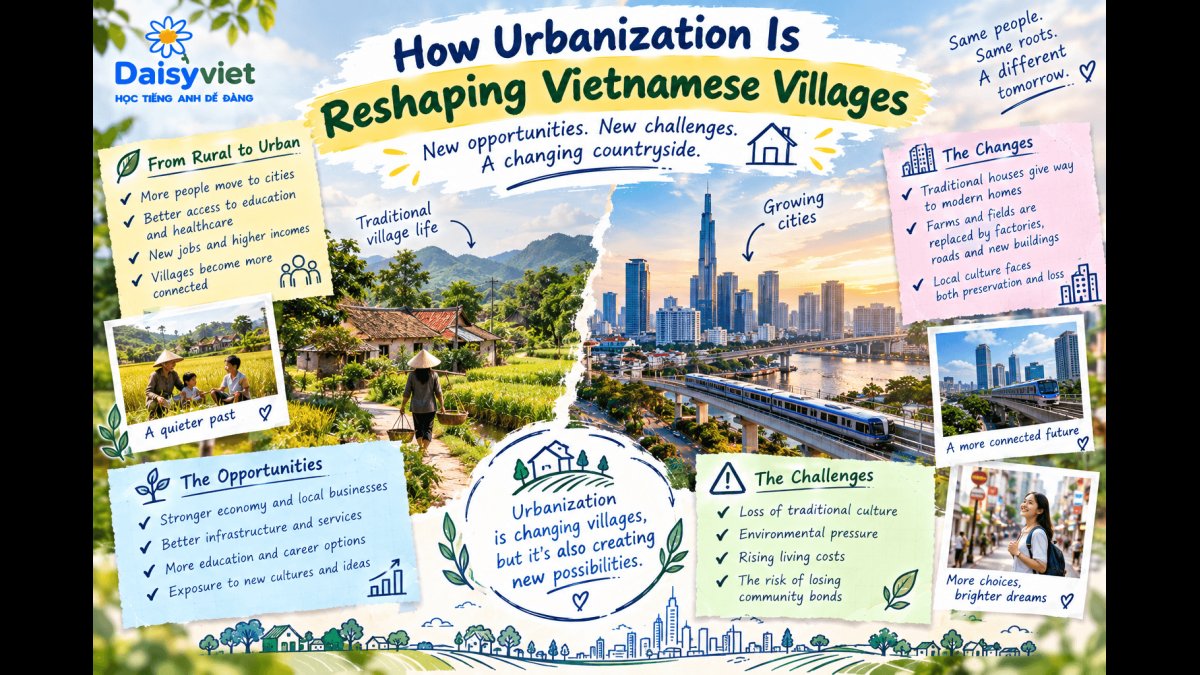
Rarely has Vietnam experienced a transformation as rapid as the urbanization sweeping across its rural villages over the past two decades. Driven by industrial growth and rising land prices, entire communes that once relied almost exclusively on rice farming have been converted into residential zones, factories, and commercial districts within a single generation.
Having grown up surrounded by rice paddies and narrow dirt paths, many older residents now find themselves living beside four-lane highways and shopping centres that did not exist ten years ago. Not only has the physical landscape changed dramatically, but the social fabric of village life has also been reshaped in ways that are only beginning to be understood.
Traditionally, Vietnamese villages were built around communal spaces — the market, the communal house, the extended family compound — where several generations lived under one roof and decisions were made collectively. This structure, having survived centuries of war and hardship, is now being challenged by a very different economic reality. Young people, lured by factory jobs and higher wages in nearby industrial parks, are increasingly choosing to live independently rather than remain within the traditional household.
Seldom do policymakers acknowledge the emotional cost of this shift. While new roads and modern housing are frequently celebrated as evidence of progress, the loss of shared land, informal community networks, and intergenerational support systems is rarely factored into official development plans. Elderly villagers, left behind as their children migrate to cities or nearby industrial zones, often describe a profound sense of disconnection from a place that has been physically transformed almost beyond recognition.
Some scholars argue that this transition, however painful, is an inevitable and even necessary stage of economic development — one that cannot be avoided if rural communes are to escape the cycle of low-income farming. Others counter that unregulated urbanization, if left unchecked, could permanently erode the cultural identity that has defined Vietnamese rural life for generations. Not until local governments begin including community input in land-use planning will this tension be meaningfully addressed.
What remains clear is that Vietnam’s villages are no longer simply agricultural spaces slowly adapting to change; they have become sites of negotiation between tradition and modernity, where every new factory built and every rice field sold represents both an opportunity gained and a way of life quietly lost.
Grammar Structure (Phân tích ngữ pháp)
- Inversion (đảo ngữ): đưa trạng từ/cụm phủ định lên đầu câu để nhấn mạnh, sau đó đảo trật tự trợ động từ/chủ ngữ. Ví dụ trong bài: “Rarely has Vietnam experienced a transformation as rapid as the urbanization”.
- Complex Passive (bị động phức tạp): kết hợp bị động với thì hoàn thành hoặc tiếp diễn để diễn đạt quá trình kéo dài. Ví dụ: “the social fabric of village life has also been reshaped in ways that are only beginning to be understood”.
- Participle Clause (cụm phân từ): rút gọn mệnh đề bằng phân từ để câu gọn gàng hơn. Ví dụ: “Driven by industrial growth and rising land prices, entire communes… have been converted into residential zones”.




💬 Bình luận (0)