

Admin
18-04-2026The Secret of the Old Clock
Oliver was a young man who lived in a very fast world. He always had his phone in his hand. He ate quickly, walked quickly, and talked quickly. He thought that being busy was the same as being happy.Lượt xem: 395 Nguồn: Sưu tầm
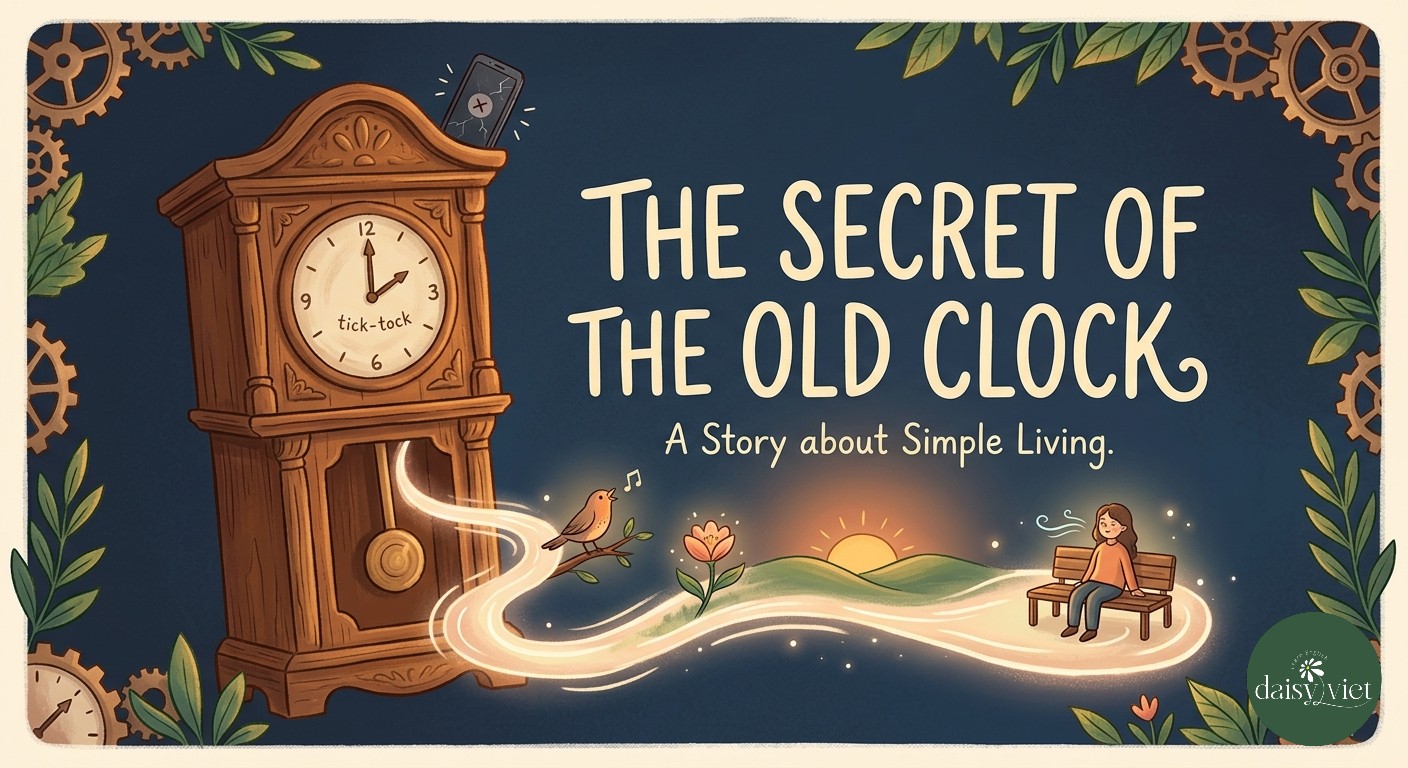
Oliver was a young man who lived in a very fast world. He always had his phone in his hand. He ate quickly, walked quickly, and talked quickly. He thought that being busy was the same as being happy.
One Saturday, Oliver visited his grandfather, Thomas. Thomas lived in a small house with a beautiful garden. Inside the house, it was very quiet. The only sound was the "tick-tock" of an old wooden clock on the wall.
"Grandpa, how can you live here?" Oliver asked. "It is so slow. Don't you feel like you are missing something?"
Thomas smiled and sat down. "I don't miss anything, Oliver. In fact, I see more than you do."
Oliver laughed. "That is impossible! I see everything on the internet."
Thomas pointed to the window. "Tell me, what color are the flowers near the gate?"
Oliver opened his mouth, then closed it. He didn't know. He had walked past them, but he hadn't noticed them.
"Life is not a race, my boy," Thomas said gently. "When you run too fast, the world becomes a blur. But when you slow down, you find the magic."
That evening, Oliver turned off his phone. He sat in the garden and watched the sun go down. For the first time in years, he heard the birds singing. He felt the cool wind on his face. He realized that his grandfather was right. Being busy was just noise. Peace was the real music.
From that day on, Oliver still worked hard, but he always made time to stop and breathe. He learned that a happy life is built from small, slow moments.
Grammar Tenses Used (Các thì sử dụng)
Trong câu chuyện này, chúng ta sử dụng chủ yếu hai thì cơ bản trong tiếng Anh:
1. Past Simple (Thì Quá khứ đơn)
-
Cách dùng: Dùng để kể lại các sự việc đã xảy ra và kết thúc trong quá khứ.
-
Ví dụ trong bài: * Oliver was a young man. (Oliver đã là một chàng trai trẻ.)
-
Thomas pointed to the window. (Thomas đã chỉ tay về phía cửa sổ.)
-
He felt the cool wind. (Anh ấy đã cảm nhận được cơn gió mát.)
-
2. Present Simple (Thì Hiện tại đơn)
-
Cách dùng: Dùng trong lời thoại của nhân vật để diễn tả sự thật, cảm xúc hoặc ý kiến ở hiện tại.
-
Ví dụ trong bài:
-
"I don't miss anything." (Ông không bỏ lỡ điều gì cả.)
-
"Life is not a race." (Cuộc đời không phải là một cuộc đua.)
-
3. Past Continuous (Thì Quá khứ tiếp diễn)
-
Cách dùng: Diễn tả một hành động đang xảy ra tại một thời điểm trong quá khứ.
-
Ví dụ trong bài:
-
The birds were singing. (Những chú chim lúc đó đang hót - dùng để miêu tả bối cảnh).
-
| 1 | Simple | /ˈsɪm.pəl/ | Đơn giản |
| 2 | Busy | /ˈbɪz.i/ | Bận rộn |
| 3 | Missing | /ˈmɪs.ɪŋ/ | Bỏ lỡ / Thiếu vắng |
| 4 | Impossible | /ɪmˈpɒs.ə.bəl/ | Không thể nào |
| 5 | Notice | /ˈnəʊ.tɪs/ | Chú ý / Nhận thấy |
| 6 | Gently | /ˈdʒent.li/ | Một cách nhẹ nhàng |
| 7 | Blur | /blɜːr/ | Một vệt mờ |
| 8 | Realize | /ˈrɪə.laɪz/ | Nhận ra |
| 9 | Peace | /piːs/ | Sự bình yên |
| 10 | Breathe | /briːð/ | Hít thở |