

Admin
05-05-2026The Kind Elephant and the Lost Cat
Leo was a very big elephant. He lived in a green forest with many trees and flowers. Leo was strong, but he was also very kind. He liked to help all the small animals in the forest.Lượt xem: 465 Nguồn: Sưu tầm
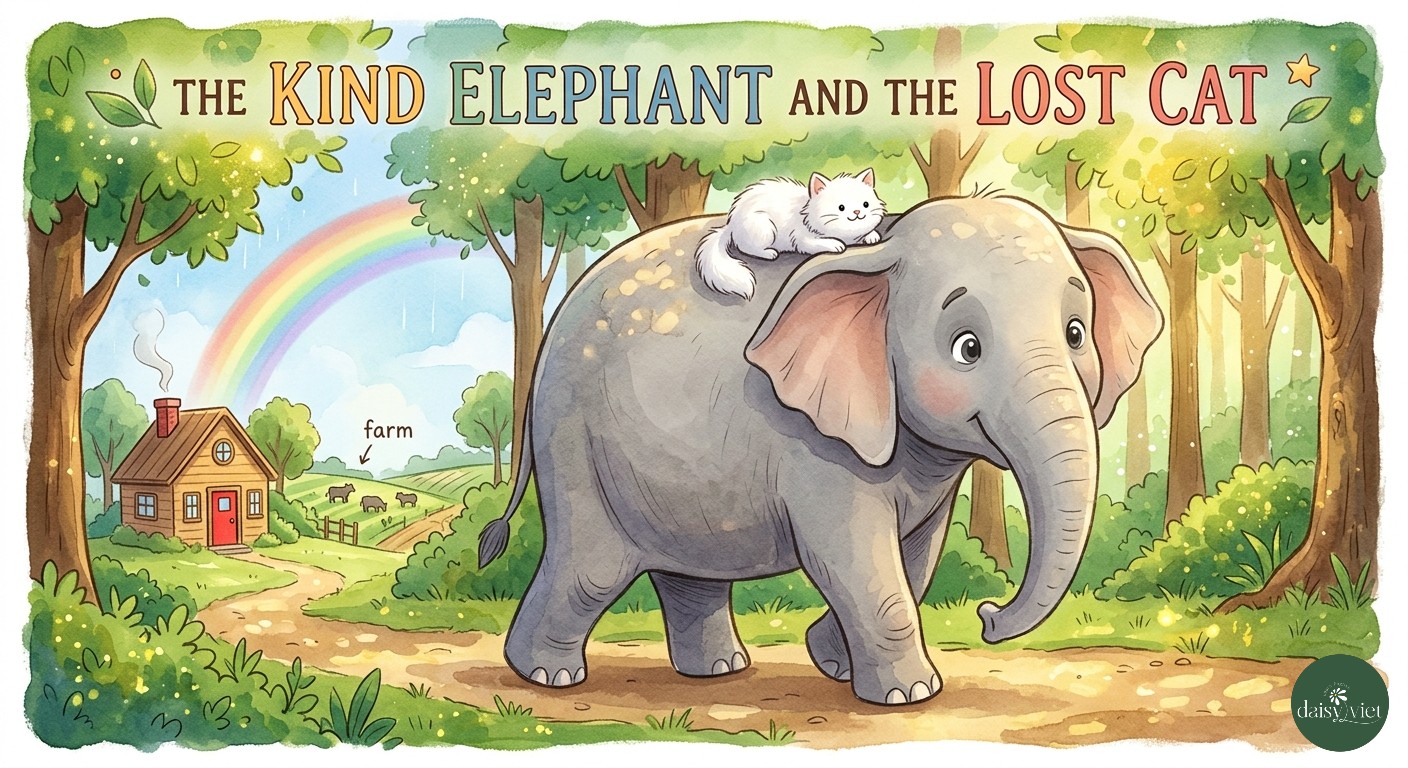
Leo was a very big elephant. He lived in a green forest with many trees and flowers. Leo was strong, but he was also very kind. He liked to help all the small animals in the forest.
One rainy afternoon, Leo was walking near the river. He heard a small sound. "Mew, mew!"
Leo looked down. Behind a big rock, he saw a small white cat. The cat was wet and very cold. She was crying.
"Hello, little cat," Leo said softly. "Why are you crying?"
"I am lost," the cat said. "I cannot find my home. The forest is too big, and I am very small."
Leo smiled and moved his big ears to keep the rain off the cat. "Do not be afraid. I will help you. Where do you live?"
"I live in a small house with a red door near the farm," the cat said.
Leo knew that place. He used his long trunk to pick up the cat gently. He was carrying the cat on his back. They walked through the tall grass and the big trees.
Suddenly, the rain stopped. The sun came out. S + V + ed: Leo spotted the house with the red door!
"My home!" the cat shouted with joy.
Leo put the cat down near the door. A little girl ran out and hugged the cat. "Thank you, Mr. Elephant!" the girl said.
Leo waved his trunk and walked back to the forest. He felt very happy. He realized that no matter how big you are, the best thing you can be is kind.
Grammar Structures (Cấu trúc ngữ pháp)
1. Past Simple (Thì Quá khứ đơn)
Dùng để kể lại các sự kiện chính trong truyện.
- Cấu trúc: S + V-ed / V2
- Ví dụ: Leo lived in a green forest. (Leo đã sống trong một khu rừng xanh.)
- Ví dụ: Leo spotted the house. (Leo đã nhìn thấy ngôi nhà.)
2. Past Continuous (Thì Quá khứ tiếp diễn)
Miêu tả hành động đang diễn ra làm nền cho câu chuyện.
- Cấu trúc: S + was/were + V-ing
- Ví dụ: Leo was walking near the river. (Leo lúc đó đang đi bộ gần bờ sông.)
- Ví dụ: He was carrying the cat on his back. (Ông ấy đang cõng chú mèo trên lưng.)
3. Present Simple (Thì Hiện tại đơn)
Dùng trong lời thoại hoặc nói về đặc điểm nhân vật.
- Cấu trúc: S + V(s/es)
- Ví dụ: "I am lost." (Em bị lạc.)
- Ví dụ: The forest is too big. (Khu rừng quá lớn.)
4. Modal Verbs (Động từ khuyết thiếu)
Nói về khả năng hoặc sự không thể.
- Cấu trúc: S + cannot + V-inf
- Ví dụ: "I cannot find my home." (Em không thể tìm thấy nhà của mình.)
| 1 | Forest | /ˈfɒr.ɪst/ | Khu rừng |
| 2 | Wet | /wet/ | Ướt |
| 3 | Lost | /lɒst/ | Bị lạc |
| 4 | Softly | /ˈsɒft.li/ | Nhẹ nhàng (giọng nói) |
| 5 | Trunk | /trʌŋk/ | Cái vòi (voi) |
| 6 | Gently | /ˈdʒent.li/ | Một cách dịu dàng |
| 7 | Spotted | /ˈspɒt.ɪd/ | Nhìn thấy/Phát hiện ra |
| 8 | Hugged | /hʌɡd/ | Đã ôm |
| 9 | Kind | /kaɪnd/ | Tốt bụng |
| 10 | Joy | /dʒɔɪ/ | Niềm vui |
can I ask you a question please? (11-06-2026)
1
pHqghUme (11-06-2026)
1
can I ask you a question please? (11-06-2026)
can I ask you a question please?
can I ask you a question please? (11-06-2026)
can I ask you a question please?