

Admin
21-04-2026The Girl Who Loved to Paint
Mia lived in a small town. She was a quiet girl, but she had a big dream. She loved to paint. Every day, after school, she went to the park with her brushes and colors. She painted the trees, the birds, and the happy children.Lượt xem: 409 Nguồn: Sưu tầm
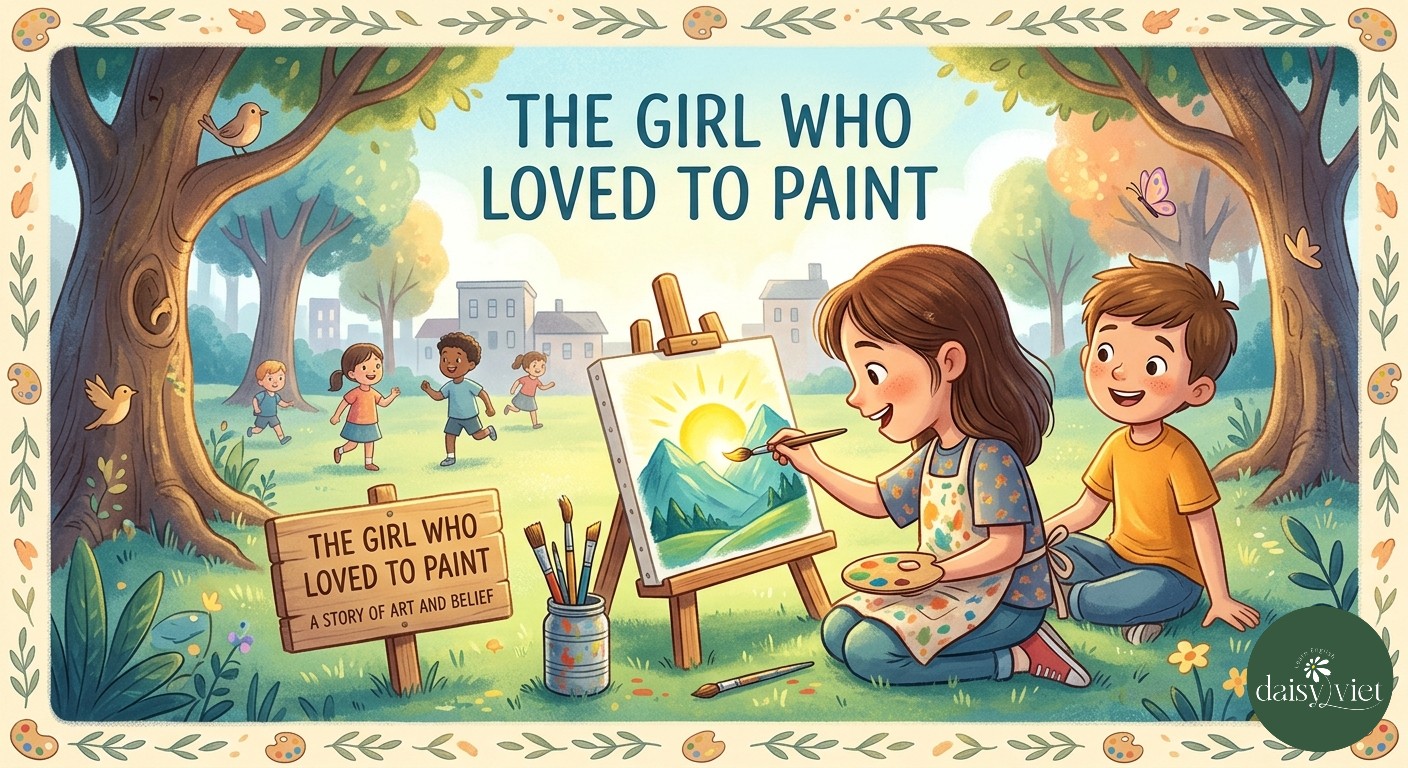
Mia lived in a small town. She was a quiet girl, but she had a big dream. She loved to paint. Every day, after school, she went to the park with her brushes and colors. She painted the trees, the birds, and the happy children.
One day, the town had a big art contest. The prize was a new set of professional paints. Mia wanted to enter, but she was afraid. She looked at her old, broken brushes. "I am not good enough," she thought. "Other people have better tools than I do."
Her friend, Sam, saw her sitting alone. "Why are you sad, Mia?" he asked.
Mia showed him her old brushes. "I cannot win with these," she said.
Sam smiled. "Mia, the magic is not in the brush. The magic is in your hand and your heart. You see the world in a beautiful way. That is what matters."
Mia took a deep breath. She decided to try. She spent three days painting a picture of the sun rising over the mountains. She used every color she had. She put all her hope into the paper.
On the day of the contest, many people came. There were many large, expensive paintings. Mia felt small. But when the judges saw her work, they stopped. They saw the bright light of the sun and the peace in the mountains.
"This painting has a soul," the main judge said.
Mia won the first prize. She realized that she did not need expensive things to be an artist. She only needed to believe in herself.
Grammar Structures (Cấu trúc ngữ pháp)
Dưới đây là các cấu trúc câu chính được sử dụng trong bài:
1. Past Simple (Thì Quá khứ đơn)
Dùng để kể lại các sự kiện đã kết thúc.
-
Cấu trúc:
S + V-ed / V2 (cột 2) -
Ví dụ: Mia lived in a small town. (Mia đã sống ở một thị trấn nhỏ.)
-
Ví dụ: She went to the park. (Cô ấy đã đi đến công viên.)
2. Past Continuous (Thì Quá khứ tiếp diễn)
Dùng để miêu tả một hành động đang diễn ra tại một thời điểm trong quá khứ.
-
Cấu trúc:
S + was/were + V-ing -
Ví dụ: Sam saw her sitting alone. (Sam thấy cô ấy đang ngồi một mình.)
-
Ví dụ: She spent three days painting. (Cô ấy đã dành 3 ngày để đang vẽ - cấu trúc spend time V-ing).
3. Present Simple (Thì Hiện tại đơn)
Dùng trong lời thoại để nói về sự thật hoặc cảm xúc hiện tại.
-
Cấu trúc:
S + V(s/es) -
Ví dụ: "I am not good enough." (Mình không đủ giỏi.)
-
Ví dụ: "That is what matters." (Đó mới là điều quan trọng.)
4. Modal Verbs (Động từ khuyết thiếu)
Dùng để nói về khả năng hoặc mong muốn.
-
Cấu trúc:
S + can/cannot + V-inf (nguyên thể) -
Ví dụ: "I cannot win with these." (Mình không thể thắng với những thứ này.)
| 1 | Contest | /kɒn.test/ | Cuộc thi |
| 2 | Matters | /ˈmæt.ərz/ | Quan trọng, có ý nghĩa |
| 3 | Hope | /həʊp/ | Hy vọng |
| 4 | Artist | /ˈɑː.tɪst/ | Nghệ sĩ |
| 5 | Enough | /ɪˈnʌf/ | Đủ |
| 6 | Professional | /prəˈfeʃ.ən.əl/ | Chuyên nghiệp |
| 7 | Soul | /səʊl/ | Tâm hồn |
| 8 | Judge | /dʒʌdʒ/ | Giám khảo |
| 9 | Deep | /diːp/ | Sâu (hơi thở sâu) |
| 10 | Tool | /tuːl/ | Công cụ |